
Understanding Dodge County Releases
A Dodge County jail release means the person has left the custody recorded by the Dodge County Sheriff's Office. It does not prove that the court case ended or that the person is free from all custody. The sheriff explains that a detainee may post bond and leave while waiting for a court hearing. Someone else may serve a local sentence, be sent to a state facility, or remain held until a court acts. The public Dodge County Interop feed makes that difference clear because its rows can show either RELEASED or CURRENTLY BOOKED.
The next record depends on what occurred. A county booking and release record stays with the sheriff. A court order can explain bond, dismissal, sentence, or probation. The Georgia Department of Corrections, or GDC, handles state-prison custody and discharge data. Parole and community-supervision agencies hold distinct post-release records. A transfer is not the same as community release. It ends one agency's custody while another agency may take control.
- Release
- Departure from a specific jail or prison's custody.
- Discharge
- Completion or formal end of a sentence or supervision term.
- Time served
- Release after the required local confinement has been credited as complete.
- Detainer
- A legal hold that may send a person to another agency instead of the community.
Dodge County Release Types
One word in a roster cannot explain every outcome. Dodge County released inmates may have active court cases, supervision duties, or another custody destination. Read the status beside the charge, bond, and court record. Then use the matching source below.
| Type | Meaning | Next source |
|---|---|---|
| Bond | Release pending a court hearing after bond was posted | Court docket or bond order |
| Time served | The credited local jail term ended | Sheriff record and sentencing order |
| Court action | A judge or prosecutor changed the basis for detention | Clerk case file |
| State transfer | County custody ended but GDC custody may have begun | GDC Find an Offender |
| Parole or probation | Community release under stated rules | Parolee Search and DCS |
| Federal hold | A federal agency may now hold the person | BOP, ICE, USMS, or federal court |
Juvenile release from Eastman YDC is separate. Adult rosters, booking-photo tools, and the GDC adult search are not suitable ways to seek a youth's identity or release details. Use DJJ and authorized court or legal channels.
A dismissal, acquittal, sentence completion, and transfer can all result in departure, yet each has a different record. The sheriff's record answers when local control ended. The clerk's file answers what the court ordered. A state locator shows whether GDC later held the person. A parole record indicates conditional community release from a prison sentence, while a probation order comes from the court. Reading those sources in sequence prevents one label from carrying more meaning than the issuing agency intended.
Dodge Releases Before Court
Dodge County's bond process explains why a person can be released while the case stays open. The Sheriff's jail-population page says a detainee gets an opportunity to post bond. If bond is posted, the person is released pending a hearing. If not, the person remains until the court makes a decision. Thus, RELEASED describes jail custody, not the final result of a charge.
A short stay can also reflect a sanction, hold, or other court process. Days in jail alone cannot establish the reason. The release record and court order work as a pair: one confirms departure, while the other supplies legal context.
Bond also affects how the public should read the charge data. The charge remains an allegation unless a court enters a conviction, and the total bond shown in Interop may relate to more than one warrant. A row can list several statutes, descriptions, and court fields. Match the whole booking rather than treating one line as the full case. If the feed and court record differ, note their update dates and ask the sheriff or clerk to clarify the official record each office maintains. That careful comparison is especially useful when a person has more than one Dodge County custody episode.
Dodge County Release Record Fields
A complete request should connect the release event to the original booking. Dodge County's Interop feed supplies useful booking-side fields, but it is not a formal release certificate. The observed feed included name, arrest date, days in jail, status, physical descriptors, total bond, warrant count, statute, charge description, misdemeanor or felony indicator, court, and image controls. Ask the sheriff to confirm release fields that the public row does not display.
| Field | What it shows |
|---|---|
| Name and identifiers | Which booking belongs to the person |
| Booking or arrest date | When that custody episode began |
| Release date and time | When local custody ended, if public |
| Release type or reason | Bond, sentence completion, court action, transfer, or another outcome |
| Charge and statute | Allegations tied to the booking, not proof of guilt |
| Bond and court | The bond total and linked court |
| Transfer destination | The next agency or facility, when public |
| Supervision | Whether parole or probation records should be checked |
Accuracy improves when the request includes the full name, approximate arrest date, and case number if known. An absent field does not prove an event never happened. Online views can omit protected data, older rows, or details that require a direct request.
The arrest date and release date serve different purposes. An arrest date starts the booking timeline. Days in jail is a calculated or displayed duration that may not explain credit awarded by a court. The release date closes custody at that facility. A transfer destination can show that another agency accepted custody, while a supervision field can point to a community officer after release. Keep the booking number or case number with any saved copy. Names can change or be entered in more than one form, but a stable agency identifier helps the sheriff locate the same episode later.
When two people share a name, compare the arrest date, physical description, court, charges, and identifiers before deciding that a row belongs to the person sought. Do not rely on a photograph by itself. Images may be unavailable, old, or subject to a separate disclosure rule. A mismatch in one key field should send the search back to the agency rather than be explained away. For an older Dodge County release, the official request path is more dependable than a screenshot of a changing public feed.
Request Dodge County Release Records
The county policy routes sheriff records to the Dodge County Sheriff at 85 Industrial Boulevard, Eastman, Georgia 31023, phone 478-559-1130, and email tgraham@dodgecosheriff.com. Ask for the booking record, release date and time, release reason if public, bond data, public transfer destination, and booking photograph if legally releasable.
- Give the full name and arrest or booking date when known.
- Describe each record sought instead of asking for every file.
- Send the focused request to the sheriff contact and keep a copy.
- Review the response, cost estimate, or stated production timeline.
- Request the court order when the release reason needs context.
Available responsive records are due within a reasonable time not exceeding three business days. If records are unavailable, the agency provides a description and timeline. Dodge County charges no labor for the first 15 minutes. Later search, retrieval, redaction, and production labor uses the hourly rate of the lowest-paid qualified employee, plus applicable copy or actual costs.
Dodge County Sheriff, Records Route85 Industrial Blvd.
Eastman, GA 31023
478-559-1130
tgraham@dodgecosheriff.com
Court records use a separate route. The Clerk of Superior Court can supply a criminal docket, bond order, sentence, probation order, revocation order, or other filed paper when it is public. State-prison records also go elsewhere. GDC asks users to verify offender-search data in writing through Inmate Records and Information in Forsyth. Parole certificates, conditional transfers, discharge orders, pardons, commutations, restoration-of-rights records, and revocation orders fall within the Parole Board record system, and the Georgia Archives schedule identifies clemency actions as permanent records. Sending the request to the office that created the document reduces delay and avoids a broad county request for a state record.
A useful request also states the preferred form of inspection or copy and asks for advance notice if charges will exceed a chosen amount. The agency may need time to locate, review, and redact responsive files. Georgia's three-business-day rule is not a promise that every large request will be fully completed within three days. It governs the response and production of available records, with a description and timeline for material that cannot yet be produced. Save all correspondence because it documents what was requested, what date range was used, and which office replied.
Restricted Dodge Release Records
Georgia public-record law permits inspection and copying unless a law or court order applies. Public access can change after record restriction. The Georgia Bureau of Investigation says arrests after July 1, 2013, are routed through the prosecutor for restriction. For older arrests, the person applies through the arresting agency. Restriction limits public access; it does not simply destroy the full record.
No result is not proof that no arrest or release occurred. A court seal, restricted record, unpublished feed-retention window, or name mismatch may explain the gap. Juvenile files, medical details, and some law-enforcement records may be withheld. Booking photographs also have special Georgia limits when remove-for-pay publication is involved.
O.C.G.A. section 50-18-72 contains exemptions that can protect privacy-sensitive data and some law-enforcement or prosecution material. An agency may release part of a file while withholding or redacting another part. That does not make the public portion unreliable. It means the requester should distinguish the fact of release from protected medical, juvenile, investigative, or personal details. If an agency cites an exemption, compare the response with the exact items requested and use the court docket for filed judicial records. The goal is a supported custody timeline, not access to every detail in an agency file.
Search Dodge County Released Inmates
Start with the system that last held the person. The local feed is best for a recent Dodge County Jail booking, GDC is best for state custody, and federal locators apply only when a federal transfer or case is supported. Court and records channels remain vital because a released person may no longer appear in a current-custody list.
- Search the Dodge County Interop feed and read the status on the correct row.
- If it says RELEASED, match charges, court, arrest date, and bond.
- If state transfer is possible, use GDC and compare identifiers, location, and release date.
- Check the Dodge County court case for bond, disposition, sentence, or probation orders.
- Use Parolee Search, DCS, or VINE when supervision or alerts are the question.
- Send a focused sheriff or GDC request when online sources do not resolve the status.
For a same-day view, the Dodge County inmates released last 24 hours page explains how to read the mixed-status feed without calling it an official 24-hour list. A missing local row may mean the person aged out of the feed. No official retention period was found.
Georgia Search for Dodge Releases
Use GDC Find an Offender for a person sentenced or transferred to Georgia state custody. The state says searches can use description, name, ID, or case number, and photos may appear when available. It can show charges, facility location, and release date. It does not replace the county feed for a bond release that never entered state prison.
| Field | Use | Note |
|---|---|---|
| GDC ID | Direct state match | Best with the exact number |
| Case number | Links a state record to a case | Use the full number |
| Name | Finds possible people | Compare all identifiers |
| Gender, race, age | Narrows common names | Supports identity matching |
| Institution | Shows state location | Separates prison from county jail |
| Release date | Shows the state date | Verify through GDC records |
The official search tells users to verify through Inmate Records and Information, P.O. Box 1529, Forsyth, Georgia 31029. The GDC search overview shown below helps identify the state route.
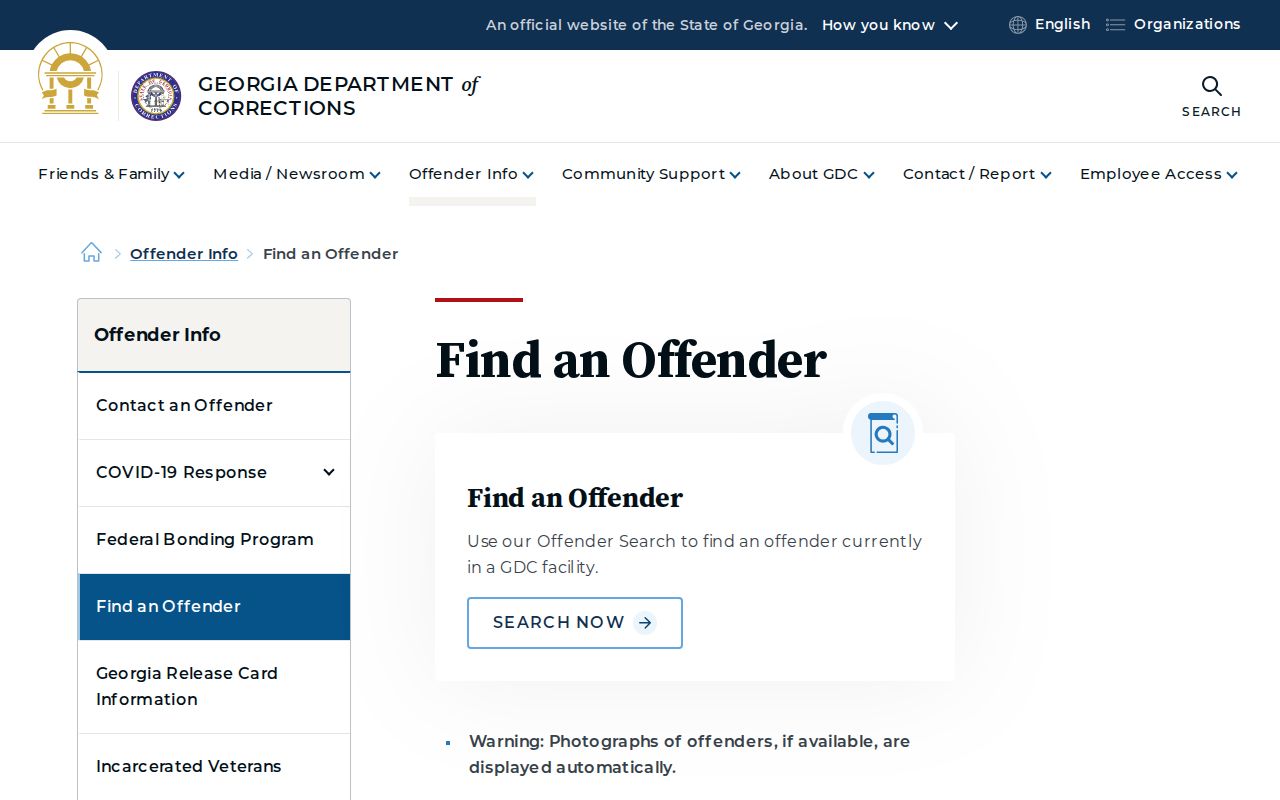
This screen applies to GDC offenders, not every person released from the Dodge County Jail.
A projected or listed release date also needs context. The Parole Board's Tentative Parole Month, or TPM, is not a final promise of release. Performance Incentive Credit may affect a target date for an eligible state prisoner, while a Maximum Release Date reflects the sentence framework. Board review, detainers, discipline, court action, offense rules, and program conditions can change the path. A Dodge County Jail sentence instead follows county rules and the court's order. Do not apply a prison parole formula to a local bond case or short county term.
GDC's tool can also help resolve the common confusion between Dodge County Jail and Dodge State Prison. The jail sits in Eastman and is run by the sheriff. The prison is in Chester and is run by GDC. A person whose Interop row reflects transfer may later appear with a state institution and state release data. Conversely, a person released on local bond may have no GDC result at all. The lack of a state result in that situation is expected, not evidence that the sheriff's released status is wrong.
Dodge County Recent Release Feed
Dodge County does not publish a clean rolling 24-hour or 72-hour list. Its Interop “Inmates By Arrest Date” feed mixes RELEASED and CURRENTLY BOOKED rows. On July 15, 2026, the observed view had 38 items across four pages. That observation proves released rows can remain visible, but it does not establish a fixed update rate or retention term.
Search by the available controls, open the matching row, and read its status rather than assuming every result is current. Arrest date and days in jail help distinguish custody episodes, while charge, court, and bond fields add context. When a recent row is gone or unclear, ask the sheriff for the release record and check the court case. No official Georgia Dodge County sheriff app was found, so do not import results from the Wisconsin site with a similar name.
The observed date is evidence of what the feed showed at that moment, not a guarantee that the same number of rows or pages will remain. The vendor's screen is organized by arrest date rather than release time. A newly released person may be found beside people who are still booked, and an older arrest can still have a recent release. For a 24-hour or 72-hour question, compare the row with a sheriff-confirmed release timestamp. If no timestamp appears, state only that the row is marked released. That wording preserves the useful online clue without inventing a rolling window that the sheriff does not publish.
Dodge Release and Court Records
Dodge County has several court paths after release. The Clerk of Superior Court provides record and case-search routes. The county courts page gives Magistrate Court contacts, while the Oconee Judicial Circuit identifies the Superior Court circuit. These sources can explain why jail status changed when the feed only proves local custody ended.
Ask for the docket, disposition or sentence order, bond order, release order, probation order, revocation order, or sentence-completion papers. The clerk is at 643 Pearl Bates Avenue, Eastman, with a mailing address of P.O. Box Drawer 4276, Eastman, Georgia 31023. The phone is 478-374-2871. GSCCCA lists public hours as Monday through Friday, 9:00 a.m. to 5:00 p.m.
Does a missing jail row close the case? No. A person can leave the feed while the court matter continues.
Magistrate and Superior Court records answer different parts of the timeline. Magistrate Court may be relevant to warrants, early hearings, or bond work, while the Superior Court clerk maintains felony court filings within its jurisdiction. The Oconee Judicial Circuit source helps confirm the court structure serving Dodge County. Start with the court named in the Interop row, then give the clerk the case number if it appears. A request for “all release information” may miss the paper that matters most. Asking for a named bond, sentencing, dismissal, probation, or revocation order gives the office a clearer target.
Court disposition and custody status may update on different schedules. A clerk can have a signed order before an online jail view changes, or the jail can process departure before a docket image becomes available. Record the source and date of each fact. If timing is important to a legal matter or planned pickup, contact the responsible office directly. A public search is a starting point, while the signed order and agency release record are the durable evidence of what each institution did.
Dodge Supervision After Release
Parole is prison release under Board conditions. Probation is a court-ordered term that may occur in the community. DCS handles felony field supervision for both. To verify parole, use the Board's Parolee Search. Results may include parole begin and end dates, office details, and primary offense.
The DCS Eastman Field Office serves Dodge County, but its physical office is at 351 8th Street South in McRae-Helena. Its number is 229-868-0023, and hours are Monday through Friday, 8:00 a.m. to 4:30 p.m. The Dodge County parole and probation record page explains how to compare court probation with state parole.
Parole and probation dates should be read beside the underlying order. A parole begin date marks the start of Board-authorized supervision after prison. A parole end date can show the expected end of that term, subject to official changes. Probation terms come from the sentencing court and may follow jail time as part of a split sentence. DCS is the practical field-office contact, but the Board or court remains the source of the legal authority. A warrant, revocation, or absconder issue can change status after the first release.
Dodge State Release Card Funds
GDC has a separate practical step for people leaving Dodge State Prison or another Georgia prison. The agency's release-card information says leftover money on an offender's books is transferred to a card after release. This is a state-prison funds process, not a field in the Dodge County Jail release record. It should not be used to infer when a local detainee posted bond or whether county property was returned.
Ask GDC about the release card when the person left state custody and had funds on the prison account. Questions about property or money held during a Dodge County Jail booking belong with the sheriff. Separating these routes matters because the jail and prison share the Dodge name but operate under different agencies, addresses, records systems, and release rules.
Dodge Release Alerts and Transfers
Georgia VINE supplies custody and case information plus status-change alerts from participating sources. A release alert reports a source update. It is not a court disposition or complete archive. If no result appears, return to Interop, GDC, court, or records channels.
Federal paths are conditional. The BOP Inmate Locator covers federal inmates from 1982 forward. BOP says a past release date with no facility means the person left BOP custody, though another justice system or supervision may apply. ICE checks current ICE custody or CBP custody over 48 hours. USMS and federal court records address remand and transfer. No Dodge source identifies the county jail as a routine ICE contract site.
A federal hold can produce two true records: Dodge says released because county custody ended, while a federal system shows continued detention. Confirm the receiving agency before describing community release.
BOP itself warns that some release dates may change as sentences are reviewed or recalculated. Its no-facility and past-date rule confirms departure from BOP custody only. ICE's Online Detainee Locator serves a different purpose because it focuses on current immigration custody and longer CBP holds, not a full historic archive. The U.S. Marshals Service may place federal prisoners in federal, state, local, or private facilities before final placement. A local building name therefore does not always identify the legal custodian. Follow the court paperwork, detainer, or transfer entry to select the correct federal tool.
Compare Dodge Custody Records
Each portal describes one slice of custody. Use this comparison when names appear in more than one system or an online row disappears.
| System | Confirms | Cannot prove alone |
|---|---|---|
| Dodge Interop | Current or released status for a retained local row | Final case result |
| Sheriff record | Local departure details when public | Later state or federal status |
| GDC search | State location and release date | Every county-only booking |
| Court docket | Bond, disposition, sentence, and probation | Real-time facility moves |
| Parolee Search | State parole record | Jail release time |
| BOP or ICE | Relevant federal custody | All local or state custody |
A practical timeline starts with the last confirmed booking, not the newest search result. Note the arrest date, agency, and status. Add the release date only when the source supplies one. Then attach the court event or transfer record that explains the change. If state custody follows, add the GDC institution and state date as a new event rather than overwriting the county release. This method preserves both true facts: the person left Dodge County custody and entered another system.
For a person returning to the community, add the parole or probation source only when it applies. VINE can record an alert, but the notice should be treated as notification evidence rather than the full reason for release. A sheriff email response, court order, GDC record, or Board entry may supply the formal basis. When two dates conflict, ask whether one is projected, tentative, processed, or actual. Those terms describe different milestones.
Older releases often require more direct work. The Interop feed has no published retention window, and a state record may show only the most recent institution. Use the approximate arrest period and case number to narrow requests. The clerk can help identify filed orders, while the sheriff can search the booking and release record. Written GDC verification is appropriate for state data. Permanent clemency-action retention at the Georgia Archives gives an additional route for older parole and discharge materials.
Keep source boundaries visible in any notes. Write “released from Dodge County Jail” when that is what Interop or the sheriff confirms. Write “released from GDC custody” when the state record supports it. Write “no longer in BOP custody” when applying the federal locator rule. Avoid shortening all three to “released” because the missing agency changes the meaning. The same care applies to “not found,” which may reflect a name issue, retention limit, confidentiality rule, or wrong portal.
Finally, verify current contact details before sending papers or planning an in-person visit. Government pages can change hours, staff assignments, forms, and portal design. The addresses and phone numbers here come from the Dodge County and Georgia sources in the project research. The originating office controls its own records and can explain current submission methods, lawful redactions, and available formats. A focused question tied to one agency is more likely to produce a clear response than a broad request sent to every office.
Dodge County Release Facilities
“Dodge” can point to three facilities and one federal path. The Dodge County Jail is the sheriff's local detention center. Dodge State Prison is a GDC medium-security prison for adult men in Chester. Eastman YDC is a juvenile campus with restricted youth information. Federal custody is a possible transfer route, not a local facility confirmed by this research.
- Dodge County Jail: use Interop, sheriff, and court records.
- Dodge State Prison: use GDC, TPM, parole, and DCS sources.
- Eastman YDC: use DJJ and authorized legal channels.
- Federal / ICE / USMS Custody: use the supported federal locator.
A release from one system may be a transfer into another. When the destination is unclear, request the local record and ask for the public transfer destination. Confirm names, dates, and agency identifiers before relying on the answer.
The primary jail's listed facility address is 5401 Anson Avenue in Eastman, and its main number is 478-374-8131. That contact is distinct from the sheriff's open-records route on Industrial Boulevard. Dodge State Prison is at 2971 Old Bethel Church Road in Chester, with GDC as its operator. Eastman YDC is at 176 Freamon Graham Boulevard and belongs to DJJ. These separate contacts reinforce the central search rule: send a custody or release question to the agency that actually held the person, and send a filed-order question to the court.