
Dodge County VINELink Release Coverage
Georgia VINE provides custody status, criminal case information, and automated notifications from participating sources. It is the statewide VINE entry for a one-person Dodge County release check. The Georgia Criminal Justice Coordinating Council describes the system as available by phone, online, and mobile access, with multilingual support and 24-hour availability.
VINE complements the Dodge County sheriff feed and Georgia state-custody tools. It is not an official archive of every person ever released. A custody change reported by a participating source can trigger an alert, but the jail record or court file remains the stronger source for the release reason. Federal BOP and ICE custody use separate locators.
- VINE
- Victim Information and Notification Everyday, a custody status and alert service.
- Custody status
- The source agency's report of whether and where a person is held or has changed status.
- Notification
- An automated message after a participating source reports a covered change.
- Disposition
- The court's result or order, which VINE does not replace.
Search Dodge County VINELink Records
Use identifying details already known from a lawful personal, notification, or court-related need. Name or ID may be offered by the current interface. Similar names require care, and a missing result should lead to another official channel rather than a conclusion.
- Open Georgia VINE at the state landing page.
- Choose the person or offender search function.
- Enter the name or ID that the interface accepts.
- Compare the returned name and available custody or source details.
- Open only the matching record and read its current custody status.
- If nothing matches, check the Dodge County Interop feed, GDC, court, or relevant federal source.
For a Dodge County Jail booking, the Interop feed is the direct local check. RELEASED means the feed no longer marks the person as booked; CURRENTLY BOOKED means it still does. For a person transferred to or released from state prison, use GDC Find an Offender. The broader Dodge County released-inmate search explains how those tracks differ.
Note: Match the source and custody type because a local jail departure can be a transfer instead of community release.
Dodge County VINE Release Results
VINE interfaces and agency feeds can change. The research safely supports custody status, case information, and status-change notification, but not a fixed Dodge-specific result-field inventory. Do not assume the screen always displays a release date, facility, or ID unless the current record actually shows it.
| Information | How to read it |
|---|---|
| Person or offender match | Use available identity and source details to avoid choosing a similar name. |
| Custody status | Read it as the participating source's current report. |
| Criminal case information | Use it as VINE-supplied context, then verify the court disposition with the court. |
| Release or no-longer-in-custody status | Confirms a reported change from that source, not the absence of all custody or supervision. |
| Notification options | Shows delivery methods offered for that record and interface. |
A release result does not explain bond, dismissal, sentence completion, transfer, or parole. For Dodge County Jail, request the booking and release record from the sheriff. For Dodge State Prison, verify the state record through GDC Inmate Records and Information. For the reason a local case changed, follow the Dodge County court record.
Register Dodge County Release Alerts
The Georgia VINE information page lists in-app, phone, email, SMS or text, and TTY notification methods where available. Options can vary by record and interface. Registration begins on the correct person's record, not from an unrelated general search result.
- Open the specific matched VINE record.
- Select the registration or notification option shown.
- Choose an offered delivery method, such as phone, email, text, in-app, or TTY.
- Enter and confirm the destination information carefully.
- Complete any PIN or confirmation step shown by Georgia VINE.
- Save the confirmation and update the registration if contact details change.
A PIN can be part of confirming or managing an alert, depending on the current interface. Do not publish or share it. If the registration is for a phone, make sure calls can be received. If it uses email or text, retain the confirmation and review message settings.
The modern Georgia VINE route is the public web and mobile notification layer. The State Board of Pardons and Paroles also describes its Victim Information Program as a 24-hour automated telephone information system operated with GDC for offender custody and status information. VIP is an additional state prison and parole status layer, not a Dodge County jail archive.
Georgia VINE and Dodge Releases
The statewide notification system is a distinctive part of a Dodge County search because local custody is only one possible track. CJCC highlighted automated offender-status notifications, online and mobile access, phone service, multilingual support, and around-the-clock availability. Those features make VINE useful while a person is in custody or during a change.
The CJCC statewide VINE announcement is shown in the captured source below.
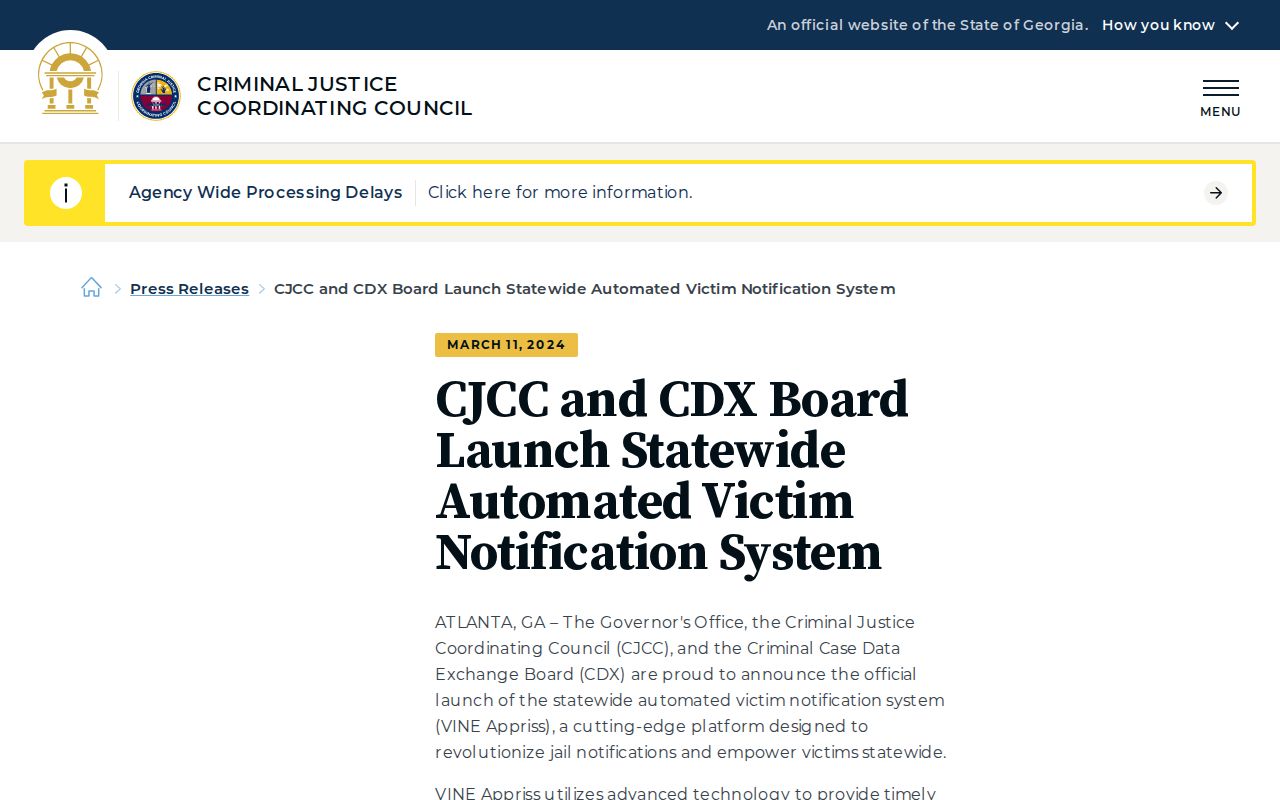
The state source supports VINE's notification role. It does not convert the service into a permanent release-record repository. Dodge County's sheriff record and court docket answer why the person left local custody.
Dodge County VINE Alert Timing
An alert follows a status report from the source system. It may not arrive at the precise moment a gate opens or paperwork is signed. A Dodge County jail release can also occur while the criminal case remains open. Treat the message as notice to verify, not as a final court result.
After a release alert, check the Interop status and the relevant court. The sheriff says local detainees may bond out pending court, remain until a court decision, serve a sentence, or transfer to state custody. Each event can lead to a custody change, yet each has a different legal meaning.
Dodge County VINELink Release Limits
VINE does not replace the BOP Inmate Locator, ICE Online Detainee Locator, or federal court and USMS records. BOP covers federal inmates from 1982 forward. Its record guidance says a past release date with no facility means release from BOP custody, while warning that another system or supervision may still apply. ICE's locator addresses current ICE custody or qualifying CBP custody, not a general release archive.
A missing VINE result can have several explanations. The identifying information may differ, the source may not be participating for that record, the status may not yet have reached VINE, or the person may belong to a local, state, federal, or juvenile system that calls for another route. Eastman YDC records should not be sought through adult roster workflows.
| Custody path | Best confirmation |
|---|---|
| Dodge County Jail | Interop status, sheriff release record, and court file |
| Dodge State Prison or GDC | GDC Find an Offender and written Inmate Records verification |
| Parole or felony probation | Parolee Search and DCS Eastman Field Office |
| Federal sentence | BOP Inmate Locator |
| ICE custody | ICE Online Detainee Locator |
Verify Dodge County Release Records
For local records, the county open-records policy routes sheriff requests to 85 Industrial Blvd, Eastman, GA 31023, phone 478-559-1130, and tgraham@dodgecosheriff.com. Ask for the booking record, release date and time, release type or reason if public, bond information, and transfer destination if public. A specific request is easier to route than a broad demand.
The Dodge County Clerk of Superior Court can supply the docket, disposition, bond order, sentence, probation order, or revocation record. Court information may explain an event after the public jail row changes. For state prison facts, GDC directs written verification to Inmate Records and Information, P.O. Box 1529, Forsyth, GA 31029.
Georgia VINE serves the alert. The originating agency and court supply the durable proof. Using both avoids treating one automated status as the whole release history.
Note: Save the alert confirmation, then record which agency and court source verified the custody change and its meaning.
After a Dodge County Release Alert
A VINE message can start a verification chain. First, identify which agency supplied the status. If it is Dodge County Jail, compare the Interop row and request the local release record. If the case is still active, the Clerk of Superior Court or the court named in the charge table may hold the bond, disposition, sentence, or probation order. That distinction prevents a custody alert from being mistaken for the end of a case.
The sheriff's own description supports several outcomes. A person may post bond and leave while awaiting court. Someone unable to make bond stays until the court acts. A sentenced detainee may remain until the sentence is served or may transfer to a state facility. Therefore, a VINE release or transfer event needs the court or agency record before anyone assigns a reason.
For state custody, the GDC search may show charges, location, and release date. The Parole Board's TPM lookup serves a different purpose: a Tentative Parole Month is not a final parole decision. For someone already on parole, Parolee Search can show begin and end dates, the parole office and number, and primary offense. DCS handles field supervision in the community.
Dodge County VINE Versus Registries
Georgia's sex offender registry is separate from VINE and from a general Dodge County jail release list. The GBI maintains the central registry under state law, while the Dodge County sheriff links to state and local registry resources. Only people subject to registration duties appear there. A registry record must never be treated as proof that every released person is listed or that a recent jail release occurred.
VINE follows custody and case status reports. The registry is a longer-term statutory record for a limited group. The jail feed shows local booking status, and the court file explains the case. Keeping these sources separate gives each result its proper meaning and avoids broad claims from one public record.