
Dodge State Prison Release Paths
Dodge State Prison is operated by the Georgia Department of Corrections. GDC identifies it as a medium-security institution for adult male felons. It is not the sheriff's county jail. A person leaving this prison follows a state custody record even though the prison stands inside Dodge County.
Release may mean parole to community supervision, completion of the prison term, a discharge, or transfer under another authority. Parole is conditional release before the maximum sentence ends. Discharge is the end of the specified custody or supervision obligation. A detainer can cause transfer to another agency instead of a trip home. The GDC record, Parole Board record, and DCS supervision record should be read together.
| Question | Correct source |
|---|---|
| Current prison or release date | GDC Find an Offender |
| Tentative parole month | Parole Board TPM Lookup |
| Released on parole | Parolee Search |
| Local field supervision | DCS Eastman Field Office |
Confirm Dodge Prison Release
Begin with GDC Find an Offender. GDC says the tool searches by description, name, ID, or case number and can show charges, facility location, and release date. Photos display automatically when available. Match more than a name, since similar names can produce the wrong state record.
- Search GDC using the strongest identifier available.
- Open the matching record and note location and release-date information.
- For parole timing, check the TPM Lookup.
- After release, use the Parolee Search for supervision fields.
- Verify uncertain state information in writing with GDC Inmate Records and Information.
A Tentative Parole Month is a review month, not a promised release date. Misconduct, program conditions, or a later Board vote can change it.
Dodge Prison Release Date Fields
Georgia uses several state-prison date concepts. The public GDC result may display a release date. The Parole Board may set a Tentative Parole Month, or TPM, for final review. GDC's Performance Incentive Credit policy defines a PIC Date that may permit consideration before a TPM or Maximum Release Date. MRD is the maximum-release concept used by that policy.
- TPM
- The tentative month when the Board completes final review and may set parole release.
- PIC Date
- An earlier consideration date for an eligible person who meets program and conduct terms.
- MRD
- The maximum release date concept tied to the sentence calculation.
- Actual release
- The custody event that occurs after final agency action and all holds are resolved.
Georgia does not use one simple percentage rule for all state sentences. General parole eligibility under O.C.G.A. § 42-9-45 has major exceptions. Serious violent felony restrictions under O.C.G.A. § 17-10-6.1, recidivist rules, crime date, Board votes, discipline, programs, and detainers can alter the result.
Dodge State Prison Contact
The facility contact is useful for institutional questions, but the statewide offender and records offices hold the authoritative release trail. Call before a visit because no public records-counter hours were established in the research.
Dodge State Prison2971 Old Bethel Church Road
Chester, GA 31012
(478) 358-7201
Fax: (478) 358-7303
Mail: P.O. Box 276, Chester, GA 31012GDC Inmate Records and Information
P.O. Box 1529
Forsyth, GA 31029
GDC expressly advises written verification before assumptions are made from an online result. Statewide inmate concerns may also be directed to (404) 656-4661 or 300 Patrol Road, Forsyth, GA 31029. Give the GDC ID, full name, and date of birth when lawfully available.
Dodge Prison Parole Supervision
The Parolee Search can show first and last name, parole begin and end dates, parole office, office number, and primary offense. DCS handles field supervision for people granted parole or reprieve and for people serving felony probation or split sentences. A split sentence combines confinement with a probation term.
The DCS Eastman Field Office serves Dodge County, despite its street address being in McRae-Helena. It is at 351 8th St. South, McRae-Helena, GA 31037, phone (229) 868-0023, and lists weekday hours from 8:00 a.m. to 4:30 p.m. The public parole record and the field office serve different roles: one displays state data, while the other handles practical supervision.
Supervision is not the same as prison custody. A released person can be outside Dodge State Prison while still bound by parole or probation conditions. Discharge occurs when that supervision ends under the governing order.
Dodge Prison Release Card Funds
GDC's release-card information explains a practical state-release detail: money left on an offender's books is transferred to a card after release. This is a state-prison process, not a Dodge County Jail booking field or bond refund.
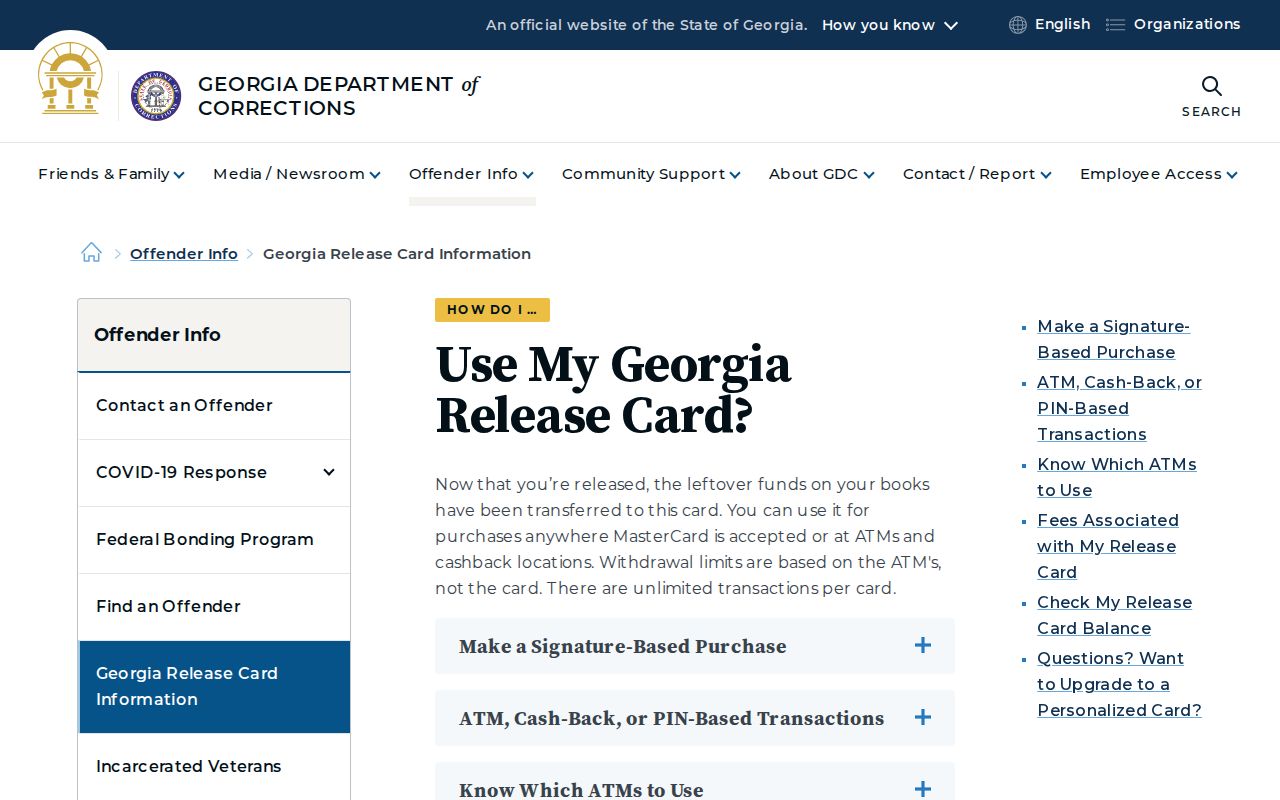
The GDC source separates release funds from custody and parole decisions.
Release funds do not prove parole, discharge, or sentence completion. They address property on the state account after the custody event. Questions about the release decision belong with GDC or the Parole Board; questions about supervision belong with DCS; questions about the card follow GDC's card instructions.
The distinction matters when family members are tracing both status and immediate release logistics. A card issue should not be mistaken for evidence that a release date changed.
Which Dodge Facility Released Them?
Dodge County houses three very different institutions: the sheriff's county jail, Dodge State Prison, and Eastman YDC. The county jail uses the local Interop status feed. Dodge State Prison uses GDC and Parole Board systems. Eastman YDC is governed by juvenile confidentiality and DJJ procedures.
Do not search the local jail roster for a Dodge State Prison discharge merely because both places share the county name. Likewise, an adult offender locator is not a proper youth-release tool. Federal and ICE locators are conditional paths used only when a detainer, federal case, or reliable record points there. This custody-first sorting prevents a false “not found” conclusion.
Dodge Prison Discharge Records
For older parole and discharge proof, the state record can outlast a changing online result. The Georgia Archives retention schedule treats clemency actions as permanent, including Board decision sheets, parole certificates, conditional transfers, discharge orders, pardons, commutations, and revocation orders. Those records may answer questions long after a person leaves the facility listing.
Georgia VINE can provide custody-change notifications when the source participates, but it is not a complete historical archive. The Dodge County released-inmate search path on the home page explains when court, county, state, or federal sources apply. For this prison, state records remain the core authority.
Dodge Prison Parole Decisions
The Georgia Parole Board reviews eligible cases and can establish a TPM or deny parole. Eligibility only allows consideration. It does not require release. Before the planned month, the Board conducts final review and decides whether to set a date. A prior decision may change before release.
Georgia's ordinary parole process is unlike a public court hearing for each prisoner. The parole handbook says incarcerated people do not personally appear before the Board for routine decisions. Public Board meetings are not personal suitability hearings for every Dodge State Prison resident.
A detainer can change the outcome. The Board may parole a person “to the detainer,” which is conditional transfer to the authority that lodged it. The prison release date can be accurate even when the person does not enter the community.
Verify Dodge Prison Records
GDC disclaims a guarantee of completeness in Find an Offender and tells users to confirm information through written correspondence. A useful letter identifies the person by name and GDC ID, states the exact field in question, and asks for the public record that confirms it.
For parole action, a permanent clemency record may include a decision sheet, certificate, conditional transfer, discharge order, or revocation order. For field supervision, DCS records and Parolee Search are more apt than a prison page. For the sentence, obtain the judgment from the sentencing court.
Each document has a boundary. The prison record proves state custody. The Board record proves parole action. The DCS record addresses supervision. No one entry answers all three.