
Dodge Federal Release Paths
No official source reviewed identified Dodge County Jail as an ICE contract facility or a dedicated federal detention center. Federal custody still can follow a local arrest. A detainer tells an agency that another authority wants custody for charges or a sentence. When Dodge County marks the person released to that hold, county custody ends but confinement may continue.
The receiving authority controls the next record. BOP covers sentenced federal inmates. ICE's locator covers current ICE detention and certain longer CBP custody. USMS manages much federal pretrial detention and transports prisoners among federal, state, local, and private facilities. A federal court docket can explain an initial appearance, release order, remand, sentence, or transfer.
| Known fact | Next source |
|---|---|
| Federal sentence | BOP Inmate Locator |
| Immigration detention | ICE Online Detainee Locator |
| Federal pretrial remand | USMS and federal court |
| Only local RELEASED status | Sheriff release record first |
Confirm Dodge Federal Transfer
Do not start with every locator. Begin with the local record or case document that points toward an agency. A charge line, detainer, court caption, alien registration number, federal register number, transfer destination, or attorney notice can select the correct route.
- Obtain the Dodge County Jail release or transfer record when local custody came first.
- Identify the receiving authority from the record rather than from rumor.
- Use BOP for a sentenced federal prisoner, ICE for current immigration detention, or federal court and USMS for pretrial custody.
- Match all available identifiers and note what the chosen system actually says.
- Check supervision or another jurisdiction if the first agency shows release.
Release from Dodge County custody is not proof of release to the community when a federal, immigration, state, or other local hold exists.
BOP Federal Release Records
The BOP Inmate Locator covers federal inmates incarcerated from 1982 to the present. It is most useful after a federal sentence has placed the person in BOP custody. BOP warns that sentence calculations and release dates may change, including review under the First Step Act, so users should check again when a date is critical.
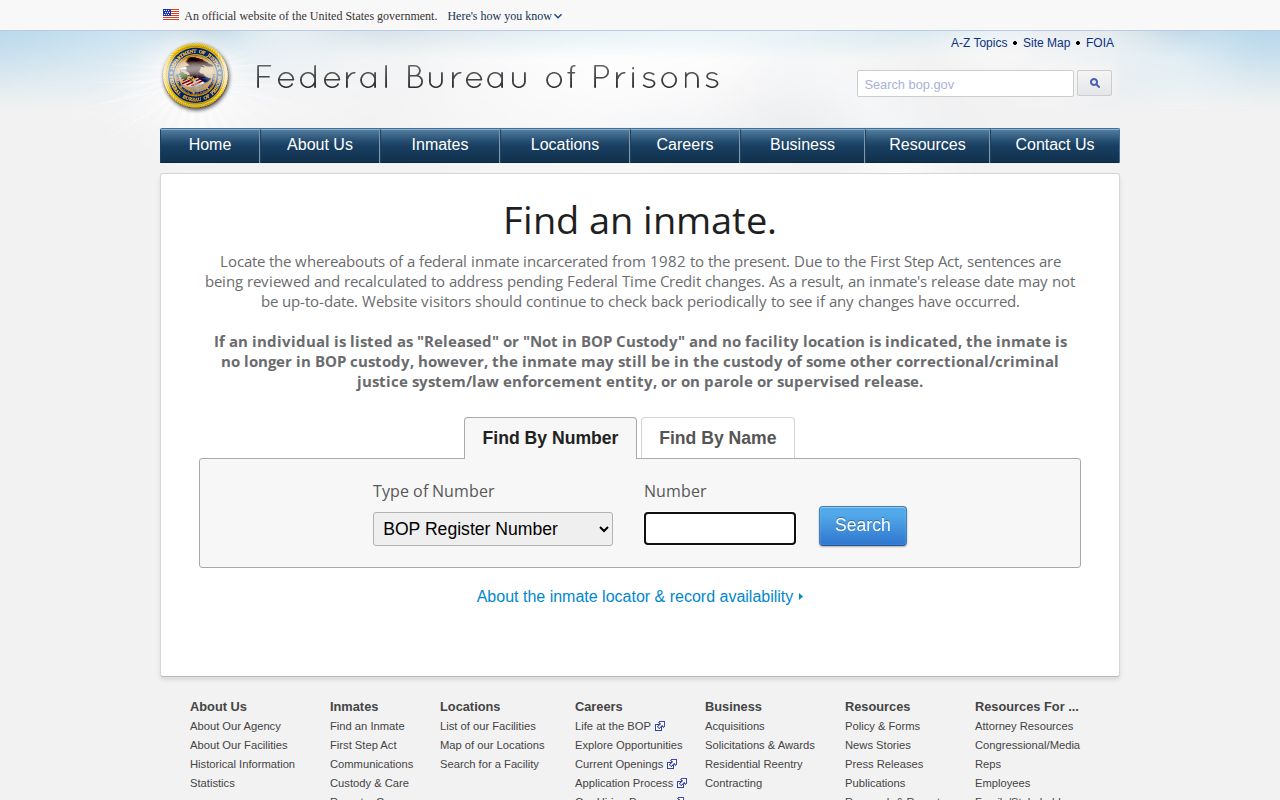
The locator capture represents sentenced federal custody, not ICE or USMS detention.
BOP's record explanation gives a precise rule. If a listed release date is in the past and no facility location appears, the person was released from BOP custody on that date. That statement does not prove the person has no supervised release, parole, state custody, local custody, or immigration custody.
A “not found” result may mean the person is pretrial under USMS, held only by ICE, outside the covered period, recorded under different identity details, or never committed to BOP. It is not a universal federal-release answer.
ICE Dodge Custody Checks
The ICE Online Detainee Locator is designed for current ICE custody and for CBP custody lasting more than 48 hours. It is not a broad archive of past immigration releases. USA.gov guidance describes two search routes: an A-number, or a combination of name, country of birth, and date of birth.
- A-number
- An immigration file number used to distinguish records.
- Detainer
- A request that another agency hold or transfer a person for the requesting authority.
- Removal
- An immigration process distinct from a county jail release.
- Supervised release
- Federal monitoring after incarceration, not continued BOP prison custody.
If ICE does not return a result, verify spelling and identifiers, then consult the attorney or official agency contact tied to the case. Do not infer deportation, release, or location from silence in the locator.
USMS Dodge Release Records
The U.S. Marshals custody process begins when a person detained under federal law is brought before a magistrate or judge. After the initial hearing, the court may order release or remand the person to the U.S. Marshal. If convicted, USMS delivers the prisoner to the institution designated for the sentence.
USMS states that it houses prisoners in federal, state, local, and private jails. Facility location alone therefore may not identify the legal custodian. A person can pass through a local jail under federal authority without becoming a sentenced BOP inmate at that point.
Federal court records are central in this phase. Look for the detention order, release conditions, remand decision, plea, judgment, sentence, and commitment documents. USMS is not presented as a public historical release list comparable to the BOP locator.
Request Dodge Transfer Records
If the trail begins at Dodge County Jail, request the booking record, release date and time, release type, and transfer destination if public from the Dodge County Sheriff open-records contact at 85 Industrial Blvd, Eastman, GA 31023, (478) 559-1130, tgraham@dodgecosheriff.com. A narrow transfer question is more useful than asking broadly for “all records.”
The local record may be redacted or may name only an agency. Use that agency name to continue. For a federal criminal matter, obtain the docket and relevant custody orders from the proper federal court. For immigration custody, use the A-number and authorized legal contacts. For a sentenced federal prisoner, use BOP's record channels.
Georgia's three-business-day records framework governs the local agency's response when applicable; it does not govern federal record systems or promise that every document is public.
Which Dodge Custody Track Applies?
Dodge County has a sheriff jail, Dodge State Prison, and Eastman YDC. None should be confused with a confirmed local federal facility. The county feed handles local adult booking status. GDC handles adult state-prison history. DJJ and juvenile courts handle protected youth matters. Federal tools apply only when the record points beyond those systems.
This overlap explains why one person may disappear from the Interop feed yet not appear in BOP. The person could be with USMS before sentence, in ICE custody, transferred to GDC, held by another county, or released under a court order. The destination field and court record are the bridge.
Start with custody ownership, not geography. Then use the matching locator.
Federal Release Is Conditional
“Released” is agency-specific. A county release ends county jail custody. A BOP release ends BOP imprisonment. An ICE locator result addresses immigration detention at that moment. None alone proves the absence of all holds, court conditions, parole, probation, or supervised release.
| Status found | What it proves | What to check next |
|---|---|---|
| County RELEASED | No longer marked booked locally | Transfer and court record |
| BOP past date, no facility | No longer in BOP custody | Supervision and other systems |
| ICE current result | Current immigration custody | Case and authorized agency contact |
| Federal release order | Court-ordered federal release terms | Conditions and later docket events |
The full Dodge County released inmates search covers the local and state paths that may need to be checked alongside these conditional federal routes.
Match Federal Custody Identities
Federal systems use different identifiers. BOP may use a register number. ICE searches may use an A-number or biographical details. A federal docket uses a case number. Dodge County may use a booking or warrant number. A name alone can be too weak when spelling or aliases differ.
Record each source and check time. Compare date of birth and other lawful details before treating a result as the same person. Do not merge two records because names match. If a court document conflicts with a locator, ask the agency or attorney to clarify.
A transfer may occur before a locator updates. The local record can establish departure from Dodge County while the receiving system catches up, but it cannot establish the final destination alone.
Federal Release Conditions Matter
A federal judge may order pretrial release with conditions or remand the person to USMS custody. After a sentence, supervised release can begin when prison ends. Supervised release is federal court monitoring, not Georgia parole or county probation.
The docket can show the release order and later changes. Read the current order. A violation, warrant, new detention order, or another hold may change custody after the event first observed in Dodge County.
Immigration release may also include reporting or case duties. The ICE locator does not provide a legal interpretation. Counsel and the responsible authority are the right sources.