
Dodge County Scheduled Release Dates
A projected date is an estimate or planned point in a sentence. The actual release is the custody event that occurs after staff check the sentence, credits, court orders, holds, and receiving agency. For a Dodge County Jail detainee awaiting trial, there may be no fixed date at all. Bond, a judge's order, dismissal, or later sentence can determine when local custody ends. A sentenced county inmate has a calculation tied to the court order and jail record.
State prison dates use different terms. GDC may display a release date. The Parole Board may publish a Tentative Parole Month, or TPM, when final review may occur. GDC policy also defines a Performance Incentive Credit Date and Maximum Release Date. None should be recast as a promise that a person will walk out on that day.
Find a Dodge County Release Date
First identify the custody system. A local booking belongs with the Dodge County Sheriff and court. A sentence at Dodge State Prison belongs with the Georgia Department of Corrections. A federal or immigration transfer requires the receiving federal system. Mixing those records is the chief cause of a wrong projected release date.
- Check the Dodge County Interop feed for CURRENTLY BOOKED or RELEASED.
- For a county sentence, obtain the sentencing order and ask the sheriff records custodian to confirm the computed date and any public hold.
- For state prison, use GDC Find an Offender by name, ID, description, or case number.
- Use the Parole Board TPM lookup when parole consideration applies. A TPM is not a final grant.
- Verify state information in writing with GDC Inmate Records and Information at P.O. Box 1529, Forsyth, GA 31029.
The Dodge County released inmate search separates these custody routes in more detail. A local RELEASED status can also mean transfer, so it does not always mean release to the community.
GDC explains that Find an Offender can show a location, charges, and release date.
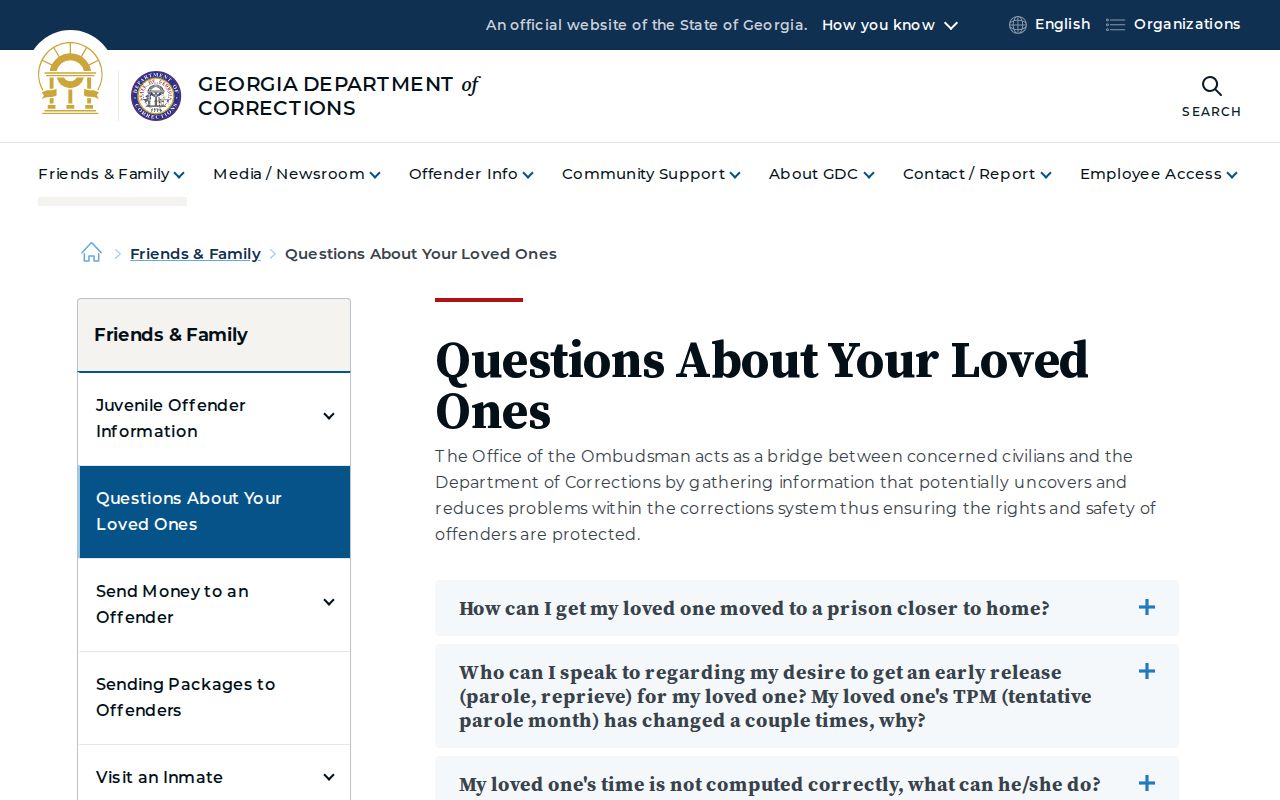
The captured state page supports the GDC route for Dodge State Prison, not a bond release from the county jail.
Dodge County Earned-Time Rules
O.C.G.A. § 42-4-7 controls county-inmate earned time. It requires custodians to maintain inmate records and permits allowances based on institutional conduct, within statutory limits. A county inmate is released at sentence expiration less earned-time allowances that were actually awarded. Court credit, a hold, or a transfer can still affect the practical date. The statute does not turn an unsentenced bond case into a fixed-term calculation.
Georgia state prison does not use a universal good-time percentage. The parole handbook says good, gained, or earned time is not broadly applied to prison sentences as in some states. Yet GDC's Performance Incentive Credit program may advance the parole timeline for an eligible person, by up to twelve months under the cited policy. PIC remains conditional and is not an automatic cut to every sentence.
Georgia also has no universal 85-percent shortcut for every state sentence. O.C.G.A. § 42-9-45 generally places parole eligibility for many felony sentences at nine months or one-third, with a six-month or one-third rule for misdemeanor sentences and a seven-year rule for aggregate terms of at least twenty-one years, all subject to exceptions. O.C.G.A. § 17-10-6.1 imposes strict limits for covered serious violent felonies.
Why Dodge Release Dates Move
A projected date changes when new facts enter the sentence or custody record. The source of the change tells the reader whom to contact. Jail staff calculate a county sentence from the controlling records. GDC maintains state custody data. The Parole Board controls parole decisions, and a court controls its own orders.
| Factor | Possible effect | Confirm with |
|---|---|---|
| Jail credit or corrected order | Moves a county or state computation | Sentencing court and custodian |
| County earned time | May shorten a county sentence within § 42-4-7 | Dodge County Sheriff records |
| TPM review | May lead to a later parole date, postponement, or denial | Parole Board |
| Misconduct or unmet program condition | May postpone or cancel a TPM | GDC and Parole Board |
| Detainer or new hold | May send the person to another agency | Holding and receiving agencies |
| Sentence recalculation | Changes the displayed estimate | Agency that owns the sentence |
A detainer is another authority's request to take or hold the person. Release from Dodge County Jail to that authority ends local custody, but not all custody. Likewise, parole to a detainer is a conditional transfer rather than a trip home.
Confirm Dodge County Actual Release
Use the projected date to plan a follow-up, then check the record again. Georgia VINE can deliver custody-change alerts through methods such as phone, email, text, in-app notice, or TTY where offered. It is a notification system, not the sentencing order or a complete historical archive.
For county custody, compare the Interop status with sheriff and court records. For Dodge State Prison, compare GDC with the TPM lookup and verify material questions through GDC records. The VINELink Release Check explains how to register for a named person's alert. Federal dates belong to BOP, and ICE's locator is mainly a current-custody tool.
A short stay also needs context. The observed Dodge County feed included a sanction-style charge description. Days in jail alone cannot prove whether the event was a sentence, probation sanction, hold, or other court process. Read the disposition before stating why the person left.
Two Dodge Release Calculations
Dodge County contains both a sheriff jail and a GDC state prison. County earned time under O.C.G.A. § 42-4-7 belongs to a local sentence. TPM, PIC, MRD, and offense-based parole eligibility belong to the state prison framework. A bond release from Dodge County Jail uses neither the TPM nor the state PIC calculation.
This split is the county's most important release-date rule. Ask who holds the person now, who imposed the sentence, and whether another agency has a detainer. Those three facts route the search to the correct record and prevent a tentative state field from being applied to a local case.
Dodge State Release-Date Fields
Three state labels answer different questions. Maximum Release Date is the outer sentence date concept used in GDC's PIC policy. Tentative Parole Month is the month the Board expects to finish final review and, when appropriate, establish a parole release date. Performance Incentive Credit Date is an earlier point at which an eligible inmate may be considered after favorable performance. Each label should be copied exactly from the matching record.
The TPM may depend on good conduct and completion of stated programs. GDC misconduct reports usually cause postponement or cancellation. PIC can produce a favorable report and possible credit, but the policy does not guarantee release. MRD can also be affected by a corrected sentence computation. For that reason, save the date of the lookup and verify close to the anticipated event.
Search fields can help prevent a false match. GDC permits searches by name, identifying description, GDC ID, or case number. The TPM application accepts a six-digit inmate number, GDC ID, or personal data. Compare more than a name. If the person has been released on parole, the Parolee Search can then show a parole begin date, end date, office, office number, and primary offense.
Older or disputed state information should be sent to GDC Inmate Records and Information in writing. For parole decisions, permanent clemency records include decision sheets, parole certificates, conditional transfers, discharge orders, and revocation orders. Those durable records are stronger than an undated screenshot when the exact sequence matters.
Dodge Jail Date Verification
The Interop feed shows arrest date and days in jail, but the observed text does not show an explicit release date field. Do not calculate a final date by adding or subtracting those values. A listed bond also does not prove the reason for release. The court order, jail computation, and sheriff release record are the sources for the actual local event.
A focused sheriff request can seek the booking record, release date and time, release type if public, and transfer destination if public. The Dodge County open-records contact is 85 Industrial Blvd, Eastman, GA 31023, 478-559-1130, and tgraham@dodgecosheriff.com. The Georgia response rule is not a promise of full production in three business days. If an available record cannot be produced in that span, the agency should describe it and give a timeline.
Use the court field in the Interop charge table to route the next request. A bond order may explain release while a case remains open. A sentence order may show credit for time already served. A probation revocation or short sanction can create a brief jail stay that cannot be understood from days in jail alone. The Dodge County Clerk of Superior Court is at 643 Pearl Bates Avenue, Eastman, with weekday public hours documented by GSCCCA.
Actual release can also occur later than expected because staff must resolve transportation, paperwork, and holds. The research does not publish a Dodge County release hour or weekend rule, so no precise time should be promised. A family member planning transportation should confirm with the current custodian close to the date and understand that staff may limit what can be disclosed.
After release, the record path changes. A state parolee may appear in Parolee Search and report through the DCS Eastman Field Office, which serves Dodge County from McRae-Helena. A person released with no supervision will not necessarily appear there. A federal release should be checked in BOP records, while a local transfer to ICE is checked through the ICE locator while custody remains current.
BOP warns that federal dates may be recalculated as credits are reviewed. A past date with no facility means release from BOP custody, but the person may remain in another system or under supervision. ICE's locator is meant for current ICE custody, not a broad archive of old release dates.
For any planned Dodge release, record the source, field label, and date checked. TPM, PIC Date, MRD, a court sentence end, and an actual release timestamp are not synonyms. Keeping those labels intact helps the sheriff, clerk, GDC, Parole Board, DCS, or receiving agency explain a later change.