
Dodge County Parole Versus Probation
Parole and probation can both place a released Dodge County person under community supervision, but they begin in different ways. The Georgia State Board of Pardons and Paroles grants parole from a state prison sentence. A Georgia court orders probation, either by itself or as part of a split sentence that includes time in custody. The Georgia Department of Community Supervision, known as DCS, supervises felony cases in both groups.
A person who posted bond from Dodge County Jail is not on parole merely because the jail feed says RELEASED. Bond means release while a case remains pending. The later court order may impose probation, dismiss the case, credit time served, or set another outcome. A person leaving Dodge State Prison may be on parole, but that must be checked in state records.
| Point | Parole | Probation |
|---|---|---|
| How it begins | Board release from a state prison term | Sentence entered by a court |
| Main public proof | Parolee Search and Board records | Criminal case disposition and probation order |
| Local supervision | DCS for felony parole | DCS for felony probation; local arrangements may apply to misdemeanors |
| End point | Parole end date or discharge order | Court term completion or discharge |
- Parole
- Conditional community release during a state prison sentence.
- Probation
- A court sentence served in the community under stated terms.
- Split sentence
- A sentence combining custody with a later term of probation.
- Discharge
- The formal end of supervision, shown by the proper agency or court record.
Check Dodge County Release Supervision
Start with the custody path. The Dodge County Interop feed is a sheriff-jail record, not a supervision database. For state parole, the official Georgia Parolee Search accepts first and last names and allows partial matches. Results can show parole begin and end dates, the parole office and phone number, and the primary offense. For probation, the signed Dodge County court order is the stronger source.
- Confirm that the local jail feed marks the person released, if the case began at Dodge County Jail.
- Search the Parolee Search by first and last name. Compare the returned state record carefully.
- If no parole result fits, check the Dodge County criminal case for a probation or split-sentence order.
- Use the office shown in the parole result or contact the DCS Eastman Field Office for Dodge-area felony supervision.
- Ask the issuing court or supervising agency to clarify an uncertain start date, end date, warrant, or discharge.
A missing result is not proof that no supervision exists. A name may differ, the record may be outside the public display, or the case may involve misdemeanor probation rather than state felony supervision. Court case numbers and GDC identifiers help separate people with similar names. The Dodge County released inmate search explains how the sheriff, court, GDC, and federal paths differ.
The official Parolee Search is the right visual reference for the state parole fields. Open the Georgia Parolee Search source before reviewing the captured interface.
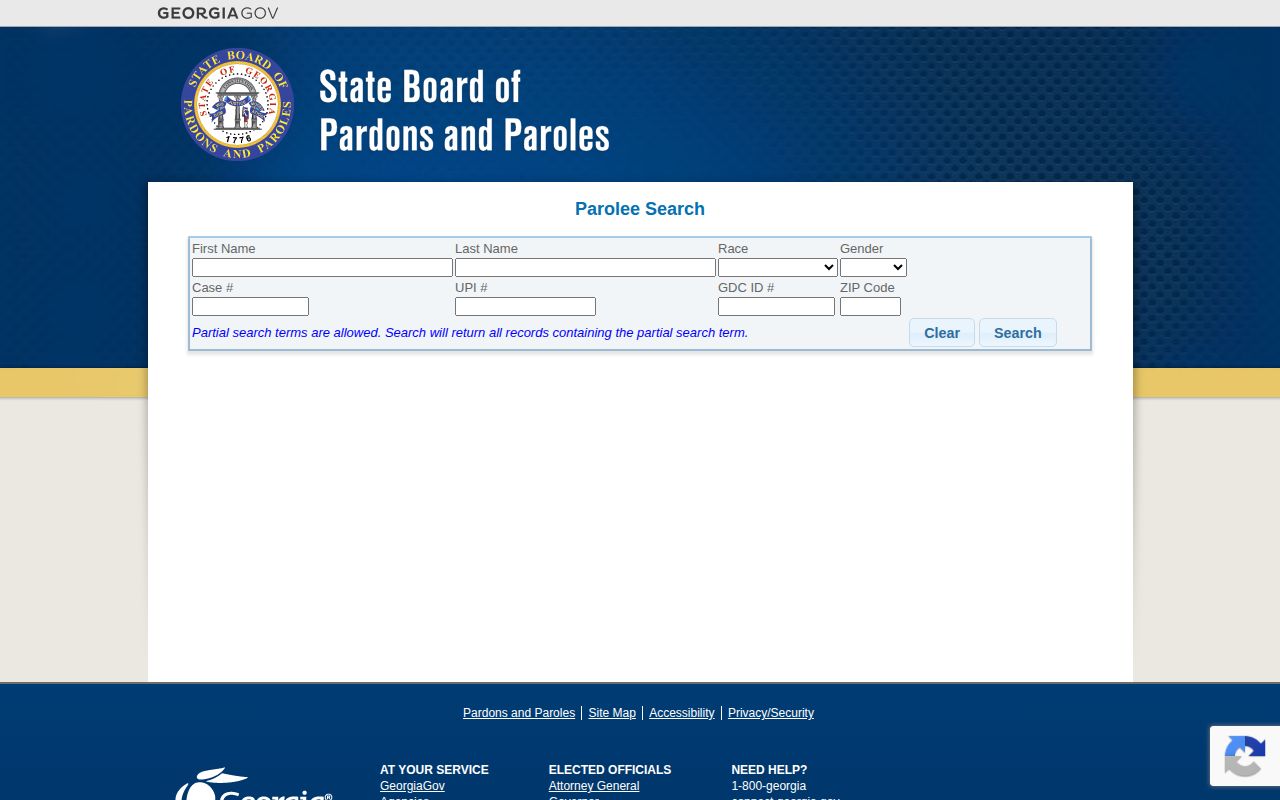
The search fields connect a released state prisoner to parole dates and an assigned office, while a county probation order still comes from the court file.
Dodge County Supervision Office Route
DCS lists the Eastman Field Office as the office serving Dodge County and the Oconee Circuit. Despite its name, the listed street address is in McRae-Helena. It also serves Bleckley, Montgomery, Pulaski, Telfair, and Wheeler counties. That broad service area makes it important to confirm the person and assigned officer before relying on the office name alone.
DCS Eastman Field Office
Address: 351 8th St. South, McRae-Helena, GA 31037
Phone: (229) 868-0023
Hours: Monday-Friday, 8:00 a.m.-4:30 p.m.
Coverage: Dodge County and the listed Oconee Circuit area
The office can address practical felony supervision questions. It is not the source for a Dodge County Jail booking record, and it does not replace the court for the terms of a probation sentence. Take a full name, case or GDC number when known, and the parole office details returned by the state search.
View the official DCS Eastman Field Office page that documents Dodge County service and the McRae-Helena location.
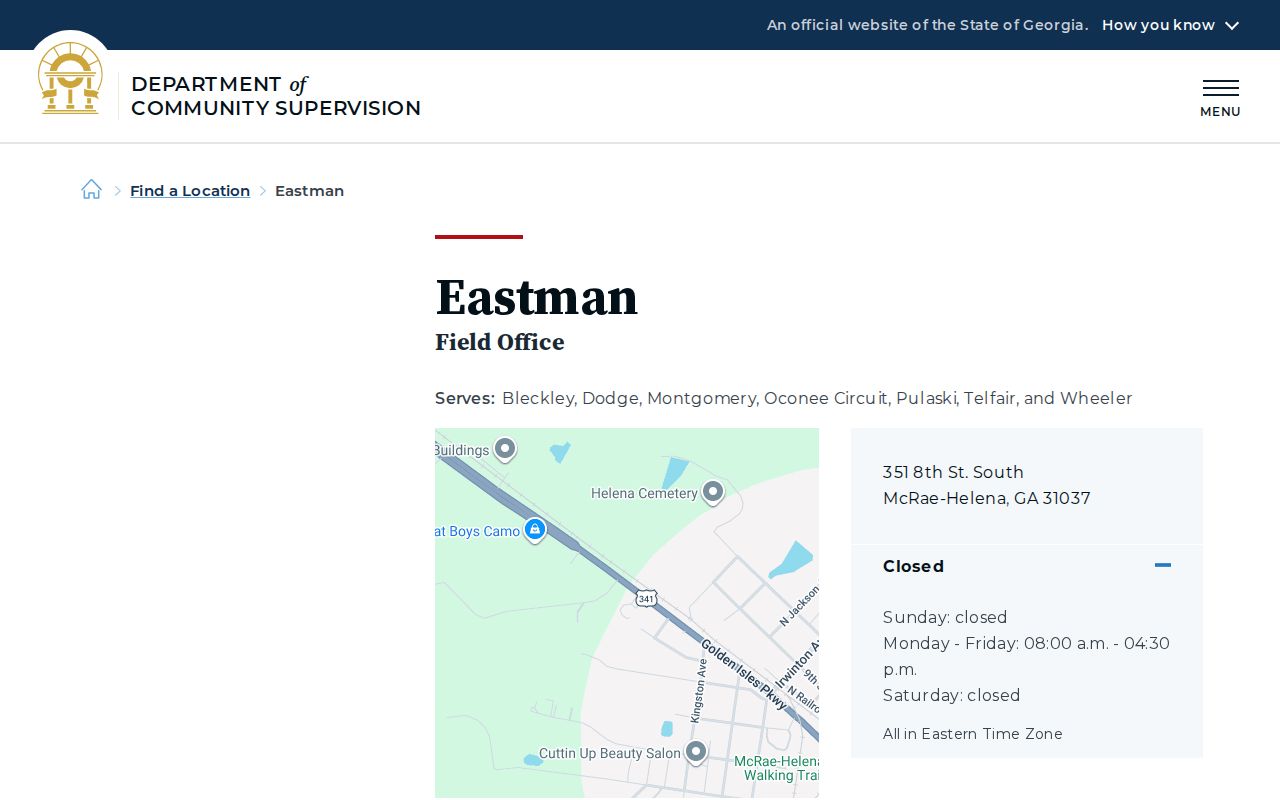
The source resolves the unusual name-and-address mismatch and gives the correct local route for Dodge County felony supervision.
Dodge County Parole Violations
Conditions are the rules attached to release. Their exact wording comes from the parole certificate, probation order, or supervising agency. An alleged breach may cause a warrant, arrest, hearing, added terms, or revocation. Revocation means supervision can be withdrawn and custody imposed under the proper process. It should never be inferred from a jail row alone.
The Parole Board states that a parolee arrested on a Board warrant receives a preliminary hearing within a reasonable time at or near the alleged violation. An independent hearing officer considers probable cause and whether the person should remain under arrest while the Board decides revocation. Thus, the Dodge County jail feed may show a new booking while the controlling parole record remains with the Board and DCS.
No official Dodge County-specific public absconder list was found. An absconder is a supervised person alleged to have stopped reporting or otherwise left supervision without authorization. Use Parolee Search, the field office, and official court or warrant records. Do not treat the lack of a web result as clearance of a warrant.
Dodge County Supervision Discharge
Supervision ends through a formal record, not simply through the passage of a date shown on an old screen. For parole, compare the begin and end dates in Parolee Search and seek the Board's discharge record when a durable confirmation is needed. Georgia's retention schedule treats clemency actions as permanent. Those records include parole certificates, conditional transfers, discharge orders, and revocation orders.
For probation, use the sentencing court's docket and order. Completion may be reflected by the end of the ordered term, a discharge, or a later court action. A Dodge County jail release date does not replace that proof. When public information is incomplete, identify the person, case number, requested record, and date range in a focused records request.
Georgia VINE can send custody-change notices, but it is not the permanent archive for parole or probation discharge. It can help track a custody event while the Parole Board, DCS, court, or records custodian supplies the legal record.
Dodge State Release Card Funds
Release logistics also differ by custody system. GDC explains that money left on a state offender's account is placed on a release card after release. That process concerns a person leaving Dodge State Prison or another GDC facility. It is not a Dodge County Jail bond record and does not show whether parole or probation applies.
The card detail can help identify which agency should answer a question. GDC handles the state release account. DCS handles felony community supervision. The Parole Board holds parole decision and discharge records. Dodge County courts hold probation orders, while the sheriff holds local booking and release records.
Dodge County Parole Decision Records
Georgia does not hold an ordinary public suitability hearing where each parole-eligible prisoner appears before the Board. Board members review the file and vote. The TPM lookup is therefore a status route, not a Dodge County court calendar. A non-life case may receive a future tentative month or a denial. The Board can reconsider a prior decision until release, and a life case follows a grant-or-deny framework.
Eligibility is also distinct from release. Under O.C.G.A. § 42-9-45, many parole-eligible felony sentences reach initial eligibility after nine months or one-third of the term, while exceptions can control. Serious violent felony provisions in O.C.G.A. § 17-10-6.1 may bar or sharply limit early release. A TPM means final review is planned for that month if conditions are met. It does not mean parole has been granted.
A detainer can change the destination. The Board may parole a state inmate to another authority's detainer through a conditional transfer. In that event, the person leaves GDC custody under the parole action but does not enter the community. Verify the receiving agency before describing the person as home or free of custody.
Records from each stage answer a different question. The TPM lookup addresses a person still being considered for parole. The Parolee Search addresses someone whose state parole record is active or displayed after release. DCS supplies the field-supervision route. A Board certificate or discharge order gives formal proof that a parole action began or ended. Dodge County court records remain the source for probation imposed in a local criminal case.
When names conflict, collect identifiers before calling. A GDC number is useful for state custody and TPM records. A court case number is useful for a probation order. A parole result can identify its assigned office and primary offense. Staff should not be asked to confirm a person from a common name alone. Dates of birth and other private identifiers should be shared only through the agency's approved process.
A parole begin date confirms state supervision started, but it does not list every term or private case note. A probation docket may identify the sentence without showing each field contact. For a precise condition, use the signed certificate or court order and assigned office. If a person returns to Dodge County Jail, compare the new arrest with the supervision record before deciding whether the cause was a Board warrant, new charge, or other hold.
Georgia VINE can supplement this work with custody-change notice. It cannot replace a discharge order, probation order, or Board revocation record. The GBI registry is separate and applies only to people with a statutory duty to register. Neither system is a general list of every Dodge County person on parole or probation.